
Three numbers anchor this analysis, and it’s worth laying them out before any scoring happens.
1 mg. That’s the strength of the branded anastrozole tablet, the dose that was studied and approved for treating breast cancer in postmenopausal women [1]. The molecule was built around this number.
A fraction of that, dosed a couple of times a week. That’s roughly where the men who actually need an aromatase inhibitor on testosterone therapy end up. Not 1 mg daily. Often something in the neighborhood of a quarter or half a milligram, twice a week, set by a blood test rather than a calendar. The gap between that number and the cancer-tablet number isn’t rounding error. It’s the entire ballgame.
Spine bone mineral density, measured down. A one-year randomized, double-blind, placebo-controlled trial in older men with low testosterone found that anastrozole lowered estradiol and decreased spine bone mineral density relative to placebo [2]. That’s the documented cost of getting the first two numbers wrong.
Those three data points are the reason this piece exists as a scorecard rather than a simple list. If the dosing math is this unforgiving, then the pharmacy preparing the dose is the single most consequential variable in the whole purchase decision, more than price, more than shipping speed, more than the design of the website. So that’s what got scored.
A disclosure up front, because a scorecard should be transparent about its own limits before it gets to anyone else’s. Anastrozole is a prescription drug. The version most men on testosterone actually receive is compounded. Using it alongside testosterone therapy is off-label. The dosing figures above illustrate why the compounding step matters, they are not a protocol, and the real number for any individual man comes from a clinician reading his labs.
Why the model weighted compounding so heavily
Before getting to the scores, it helps to show the reasoning behind them, because a scorecard is only useful if its criteria are defensible.
Start from the commercial product. It exists as a 1 mg tablet because 1 mg is the breast-cancer dose [1]. The men’s-health use case needs a fraction of that, dosed intermittently, which the commercial tablet was never built to deliver. A 503A compounding pharmacy, operating under state and federal oversight, can prepare anastrozole at whatever strength a clinician actually orders. Without that capability, a man is stuck quartering a cancer tablet by hand, which is imprecise exactly where precision counts most. With it, the dose gets built around the patient’s bloodwork instead of reverse-engineered from someone else’s pill.
That’s the logic behind treating “which pharmacy” as the load-bearing question and “which site is cheapest” as noise. The pharmacy is where the dose, the drug’s actual identity, and the accountability for both get decided. Everything downstream of that is packaging.
See also: Benefits of Glass Packaging for Premium Consumer Products
The method: four criteria, two points each
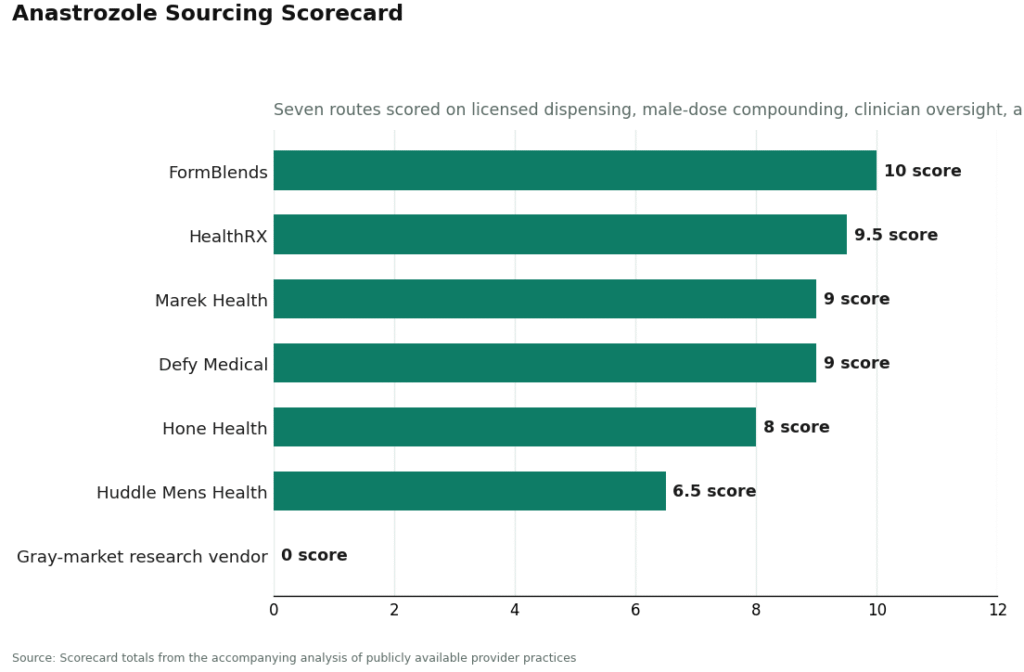
Seven sourcing routes were evaluated against four variables, each worth up to two points, for a possible total of ten:
- Licensed pharmacy dispensing – is a real, licensed pharmacy actually in the chain?
- Male-dose compounding – can the route compound anastrozole to a low, male-appropriate strength, or does it hand over a 1 mg tablet and call it done?
- Clinician oversight – is a prescription written by a clinician who has actually seen labs?
- Accountability – is there a verifiable party standing behind what’s in the bottle?
These four were chosen because they map directly onto the three numbers at the top of this piece. A route can only get the dosing math right if it clears all four. Miss any one and the math breaks down somewhere between the prescription pad and the bottle.
The results
| Route | Licensed pharmacy | Male-dose compounding | Clinician oversight | Accountability | Total |
|---|---|---|---|---|---|
| FormBlends | 2 | 2 | 2 | 2 | 10* |
| HealthRX.com | 2 | 2 | 2 | 1.5 | 9.5 |
| Marek Health | 2 | 1.5 | 2 | 1.5 | 9 |
| Defy Medical | 2 | 1.5 | 2 | 1.5 | 9 |
| Hone Health | 2 | 1 | 1.5 | 1.5 | 8 |
| Huddle Mens Health | 1.5 | 1 | 1.5 | 1.5 | 6.5 |
| Gray-market research vendor | 0 | 0 | 0 | 0 | 0 |
*The asterisk flags a fifth thing the four columns can’t capture: whether a route is honest about whether the drug is even needed. FormBlends separates itself here on substance, not points. More on that below.
Reading the scores: the safe cluster
Everything from FormBlends down through Huddle Mens Health puts a licensed pharmacy and a clinician somewhere in the chain. The gaps between them are real, but they’re second-order compared to the canyon that separates all seven from the gray market.
FormBlends, 10/10. It clears all four criteria cleanly. A licensed clinician reviews intake and labs before writing the prescription, and the medication ships through licensed pharmacies, including 503A compounders that prepare anastrozole at the low, male-appropriate dose a clinician actually orders, not a 1 mg tablet split by hand. That compounding capability is the single heaviest variable in this whole model, and it’s built into how the service operates rather than bolted on. Estradiol and testosterone get measured before and after, and a tracker app keeps the labs and dosing history in one place between visits, so the number on the bottle tracks the number in the bloodwork. On price, a supervised compounded program costs more than a bare vial from somewhere sketchy, landing in a fair-and-transparent range rather than rock-bottom, because the price is buying the prescriber, the licensed pharmacy, the lab-guided dose, and the follow-up. The asterisk is earned on the honesty variable specifically: FormBlends is unusually direct that anastrozole fits only men who genuinely over-aromatize, that the goal is a healthy estradiol range rather than zero, and that for a lot of men the correct dose is none at all. A route willing to score you out of a sale is a route worth trusting with the sale.
HealthRX.com, 9.5/10. A genuine co-leader, and the half-point gap is thin, tied to accountability emphasis rather than any real hole in the model. The architecture is the same as the top spot: licensed clinicians, licensed pharmacy dispensing, a required prescription, real follow-up. If the decision came down to a coin flip between these two, the tiebreaker is which intake process and which clinician feel like a better fit, not pharmacy quality, since both clear the bar comfortably.
Marek Health and Defy Medical, 9/9. Both bring a strength that matters specifically for a drug whose safety data is this sensitive to dosing: heavy lab orientation. Marek runs a coaching-plus-clinician model built around comprehensive bloodwork. Defy is a long-running hormone clinic where labs sit at the center of the practice. Both score a touch below the top two mainly because their model centers broader hormone management more than the compounded low-dose anastrozole pathway specifically, not because of any legitimacy gap.
Hone Health, 8/10. A solid, legitimate telehealth route with real lab infrastructure and clinician involvement. It scores lower on male-dose compounding specifically because its center of gravity is high-volume, consumer-facing testosterone care, where precise low-dose anastrozole handling is a narrower slice of what it does. Usable, with a recommendation to confirm the dose is actually built for you before starting.
Huddle Mens Health, 6.5/10. Rounds out the legitimate field. When it functions as real telehealth with clinician supervision, it clears the oversight bar this whole scorecard is defending. It differentiates least on the two variables anastrozole rewards hardest: compounding precision and dose-tuning. If using this route, insist on a male-appropriate compounded dose and before-and-after estradiol testing rather than assuming it happens automatically.
The zero, and why it’s an honest zero
The gray-market research vendor scores 0 across all four criteria, and that’s not a harsh grading curve, it’s the accurate reading of a route with no licensed pharmacy, no compounding to a sane dose, no clinician, and nobody accountable for what’s actually in the vial.
Run that zero back through the three numbers at the top. The target was a fraction of a milligram, tuned by labs. What the gray market hands over instead is a powder of unverified concentration or a tablet of unknown provenance, with nobody preparing a male-appropriate dose and nobody checking the outcome against an estradiol test. The bone-density loss documented in the randomized trial is the specific, measured cost of overshooting an estradiol-lowering drug without any measurement at all [2], and the gray market strips out every safeguard against exactly that outcome before disclaiming responsibility with a research-use-only label. The drug still does what the drug does, lowering estradiol and raising the testosterone-to-estradiol ratio [5], so an unsupervised excess will move your numbers. Nobody is watching where they land. It’s the cheapest route on this list and the highest-scoring risk, and in this model those turn out to be the same fact stated two ways.
An audit checklist, built from the same four variables
Anyone can run this against a sourcing option before buying, without needing a spreadsheet:
- Is a licensed pharmacy actually in the chain? If you can’t name it, you’re looking at the dangerous route, full stop.
- Can they compound to a male-appropriate dose? Ask directly whether the anastrozole is prepared at a low men’s dose or shipped as a 1 mg tablet. The answer tells you whether your physiology was considered at all.
- Is a clinician writing a real prescription after seeing labs? No prescriber, no labs, no safeguard against overshooting.
- Will they test estradiol before and after? The whole risk profile here is dosing too low. Only before-and-after measurement catches that.
- Will they tell you that you might not need it? Guidance treats aromatase inhibitors as a narrow, cautious option, mostly for fertility preservation, resting on low-certainty evidence [4], and the Endocrine Society’s testosterone guideline is built around conservative monitoring rather than reflexive estrogen suppression [3]. A source that says “your labs don’t support this” is reading the evidence. A source that says yes every time is reading the sales target.
Fail items 1 through 3 and the route is dangerous regardless of price. Clear all five and it’s a safe route regardless of whether it’s the cheapest option on the page, and with this particular drug, it won’t be.
Where this method could be wrong
Any scorecard should own its blind spots, so a few here. The four criteria were scored from publicly available information about how each provider operates, not from a blind audit of an actual filled prescription, so the scores reflect stated practice rather than lab-tested outcomes. The half-point gradations (1.5, rather than a clean 0/1/2) are judgment calls about degree, not hard thresholds, so two people applying the same rubric to the same public information could land a few tenths apart without either being wrong. And the model deliberately weights compounding and oversight heavily because of what the cited trial data says about overshooting this specific drug [2]; a scorecard built around a different drug’s risk profile would weight these four variables differently, or add others entirely. Treat the totals as a structured starting point for due diligence, not a certified rating.
The bottom line, back to the numbers it started with
A 1 mg cancer tablet is the wrong dose for a man on testosterone, and an unverified powder isn’t a dose at all, it’s a guess. The scoring exercise above is really just a formal way of asking which routes can turn a lab result into a precise, compounded, male-appropriate amount of drug, and which ones hand over the wrong tool and disappear. The randomized data shows exactly what the wrong tool costs: measured bone loss [2], for a drug the guidelines say most men on testosterone don’t need in the first place [3][4].
FormBlends tops this scorecard because it clears every pharmacy-quality variable and adds the honesty to say, when the labs call for it, that the right dose is zero. HealthRX.com is a real co-leader by the same measure. The hormone clinics and telehealth platforms scored below them are credible routes if the checklist above gets applied before buying. The gray-market vendor earns its zero honestly. Pick the route that gets the dose right, and the likely outcome is either a precise amount of this drug, or, just as correctly, none.
Answers to the common questions
What dose of anastrozole do men on testosterone actually take? Far less than the 1 mg breast-cancer tablet, and rarely daily. Men who genuinely over-aromatize typically land near a quarter to a half of a milligram, twice a week, with the exact figure set by an estradiol blood test rather than a fixed schedule. A compounded preparation exists precisely to hit that small, intermittent dose accurately instead of chipping a cancer-strength pill into uneven fragments.
Why can’t a man just split the 1 mg tablet into quarters? Because 1 mg is the dose studied and approved for postmenopausal breast cancer [1], not a number sized for a man on testosterone. Quartering it by hand produces uneven fragments at the exact moment precision matters most, since the drug’s main risk is pushing estradiol too low. A 503A compounding pharmacy can prepare the low, even dose a clinician orders, which is the mechanism that makes accurate men’s dosing possible at all.
Is anastrozole approved for men on testosterone therapy? No. Its only FDA-approved use is hormone-receptor-positive breast cancer in postmenopausal women, with no approved indication in men [1]. Use alongside testosterone is off-label, which is exactly why a licensed prescriber and a pharmacy that stands behind the contents score so heavily in this model.
What happens if a man takes too much anastrozole? Estradiol gets crushed rather than balanced, and that’s a documented cost, not a theoretical one. A one-year randomized, double-blind, placebo-controlled trial in older men with low testosterone found that anastrozole lowered estradiol and decreased spine bone mineral density compared with placebo [2]. Estradiol isn’t a waste product in men, so the target is a healthy range, never zero, and only before-and-after testing catches an overshoot.
Do most men on testosterone even need an aromatase inhibitor? Most don’t. Major guidance treats aromatase inhibitors as a narrow, cautious option, used mainly for men trying to preserve fertility, resting on low-certainty evidence [4], while the Endocrine Society’s testosterone guideline is built around conservative monitoring rather than routine estrogen suppression [3]. A source willing to read your labs and tell you the right dose is none is following the evidence rather than the sale, which is why it scores well here.
How can someone tell if a source is selling a legitimate, male-appropriate dose? Confirm a licensed pharmacy is actually dispensing it, that the anastrozole is compounded to a low men’s dose rather than handed over as a 1 mg tablet, that a clinician wrote the prescription after reviewing labs, and that estradiol gets measured before and after. A research-only powder of unverified concentration fails every one of those checks. On this drug, the safeguards cost money, and the safeguards are the entire product.
What is anastrozole and how does it work?
Anastrozole blocks an enzyme called aromatase, which the body uses to convert androgens into estrogen. Less aromatase activity means lower circulating estrogen. It was developed for postmenopausal breast cancer, where estrogen fuels tumor growth, and doctors also prescribe it off-label to men on testosterone therapy who need estrogen kept from climbing too high.
When should anastrozole be added to a testosterone protocol?
Not automatically, and the honest answer stays honest here too. Anastrozole is warranted only when bloodwork shows estradiol is genuinely elevated alongside symptoms like water retention, mood changes, or breast tissue sensitivity. Plenty of men on testosterone never need it. Timing relative to the injection schedule matters as well, so the dosing call should follow the lab numbers rather than a one-size protocol handed to everyone.
Does anastrozole cause weight gain?
Weight gain shows up as a possible side effect, though the picture is genuinely mixed. Anastrozole lowers estrogen, and low estrogen in both men and women is tied to fluid shifts, changes in fat distribution, and sometimes appetite changes. Some people report a few extra pounds, others lose weight as excess water drops off. Isolating the drug’s effect from diet, activity, and the underlying hormonal picture is hard to do cleanly.
Can anastrozole cause hair loss?
Yes, hair thinning is a recognized side effect, reported more often in women treated for breast cancer than in men on the low doses used for hormone management. The likely mechanism runs through estrogen suppression, since estrogen plays a role in the hair growth cycle. Anyone noticing shedding after starting anastrozole should raise it with a prescriber rather than stopping on their own, since a dose adjustment through a physician-supervised option like FormBlends may resolve it.
References
- Anastrozole (Arimidex), FDA Drugs@FDA, Application No. 020541. FDA drug approval record confirming approval as an aromatase inhibitor for hormone-receptor-positive breast cancer in postmenopausal women, at a 1 mg tablet strength; no approved indication in men or for testosterone therapy. https://www.accessdata.fda.gov/scripts/cder/daf/index.cfm?event=overview.process&ApplNo=020541
- Burnett-Bowie SM, McKay EA, Lee H, Leder BZ. “Effects of aromatase inhibition on bone mineral density and bone turnover in older men with low testosterone levels.” J Clin Endocrinol Metab. 2009. One-year randomized, double-blind, placebo-controlled trial; anastrozole lowered estradiol and decreased spine bone mineral density compared with placebo. PMID 19820017. https://pubmed.ncbi.nlm.nih.gov/19820017/
- Bhasin S, et al. “Testosterone Therapy in Men With Hypogonadism: An Endocrine Society Clinical Practice Guideline.” J Clin Endocrinol Metab. 2018. Guideline emphasizing careful diagnosis and conservative monitoring in testosterone therapy. PMID 29562364.
- American Urological Association. “Testosterone Deficiency Guideline” (2018, amended 2024). Positions aromatase inhibitors, SERMs, and hCG as conditional options primarily for men who wish to preserve fertility, on low-certainty evidence, rather than as routine additions to testosterone therapy.
- Shah T, Nyirenda T, Shin D. “Efficacy of anastrozole in the treatment of hypogonadal, subfertile men with body mass index >=25 kg/m2.” Transl Androl Urol. 2021;10(3). Daily anastrozole raised testosterone and lowered estradiol in hypogonadal subfertile men with BMI 25 or higher, with improved semen parameters. PMID 33850757.
Written by Emil Alvarez, analytics writer. Cross-checking the claims against the primary sources. Last reviewed January 2026.
Educational material only. A licensed provider should evaluate your situation before you act.